
AI answers can mention your brand before a buyer ever visits your site. The hard part is earning that mention across ChatGPT, Perplexity, AI Overviews, and other answer engines.
Here are the best generative engine optimization services, with the right fit, main strength, and tradeoff for each.
1. Kadima Digital, Integrated SEO and AEO for Visibility and Leads
Kadima Digital is a digital marketing agency that connects SEO, AEO, content, PPC, and lead generation. It is our recommended pick for brands that need AI visibility tied to commercial outcomes.
AI search work still needs a strong search base. Pages must be crawlable, useful, clear, and supported by trusted signals. Kadima Digital brings those pieces into one plan instead of treating GEO as a separate content trick.
That means we can start with an SEO audit, fix technical barriers, improve page structure, then build content around questions buyers ask. We also connect the work to lead forms, landing pages, paid search, and sales follow-up. The point is simple: more qualified visibility should lead to more leads, not just more screenshots.
We also keep the basics in view. Structured data can describe services, FAQs, reviews, and local business details. Clear headings help both readers and retrieval systems find the answer they need. Structured data uses a shared vocabulary to mark up information on web pages.
The caveat is capacity. An integrated program needs access to your site, analytics, sales process, and subject experts. Teams that only want a quick AI visibility report may find this approach broader than needed.
For companies serious about scaling, that broader view is the advantage. We do not promise a fixed citation or ranking. We build the source environment that gives your brand a fair chance to be found, understood, and chosen.
2. Percepture, AI SEO, GEO, Digital PR, and Sales Activation
Percepture is a strong fit for companies seeking AI SEO, GEO, digital PR, content architecture, and sales activation.
Its published pricing structure starts AI SEO and GEO programs at $6,000 per month, with a one-time project initiation fee of $2,900. That makes Percepture the only reviewed provider with disclosed pricing details. Buyers still need to confirm scope, staffing, contract terms, and expected deliverables.
Percepture also describes a wide integration suite. That detail matters because many providers describe AI visibility in broad terms without saying how work enters the sales process.
This option suits a company with a longer buying cycle. A B2B team may need its service pages, expert profiles, PR mentions, prompt tracking, and lead routing to reinforce the same market position.
The tradeoff is cost and setup. A program at this level needs a clear business case. If your site has weak source content or no sales owner for incoming demand, integrations will not fix the gap by themselves.
There is a wider market problem here. Pricing and integration details were missing for most of the providers covered. Percepture wins on transparency, but transparency still means asking hard questions before signing.
3. iPullRank, Technical SEO Thinking and Advanced Search Testing
iPullRank fits teams that value technical SEO thinking and advanced search testing. Its approach is a better match for sites where crawl paths, information structure, and search behavior need close study.
Technical work matters because answer engines still need access to source pages. A page hidden behind poor navigation, heavy scripts, blocked resources, or unclear relationships gives retrieval systems less useful material to work with.
A technical-first engagement can examine how pages connect, which templates carry the most value, and where search intent breaks across a large site. It can also help teams test how changes affect organic search and AI answer visibility over time.
This fit is strongest for a company with developers, complex templates, or a large content system. It is less suited to a small firm that mainly needs service pages, local signals, and a simple content plan.
Technical SEO also cannot replace proof. Reviews, expert information, case material, and third-party mentions still help answer engines judge whether a brand deserves trust. Our Technical SEO Services That Fix Ranking Barriers page covers the same foundation from an execution standpoint.
Pick this type of provider when your visibility problem looks like a system problem. If the issue is thin content or weak authority, technical testing alone will leave the main gap untouched.
4. First Page Sage, Research-Style Thought Leadership Content
First Page Sage suits buyers who want research-style SEO content with a thought-leadership-heavy approach. It is a sensible option for brands that need a strong point of view around complex subjects.
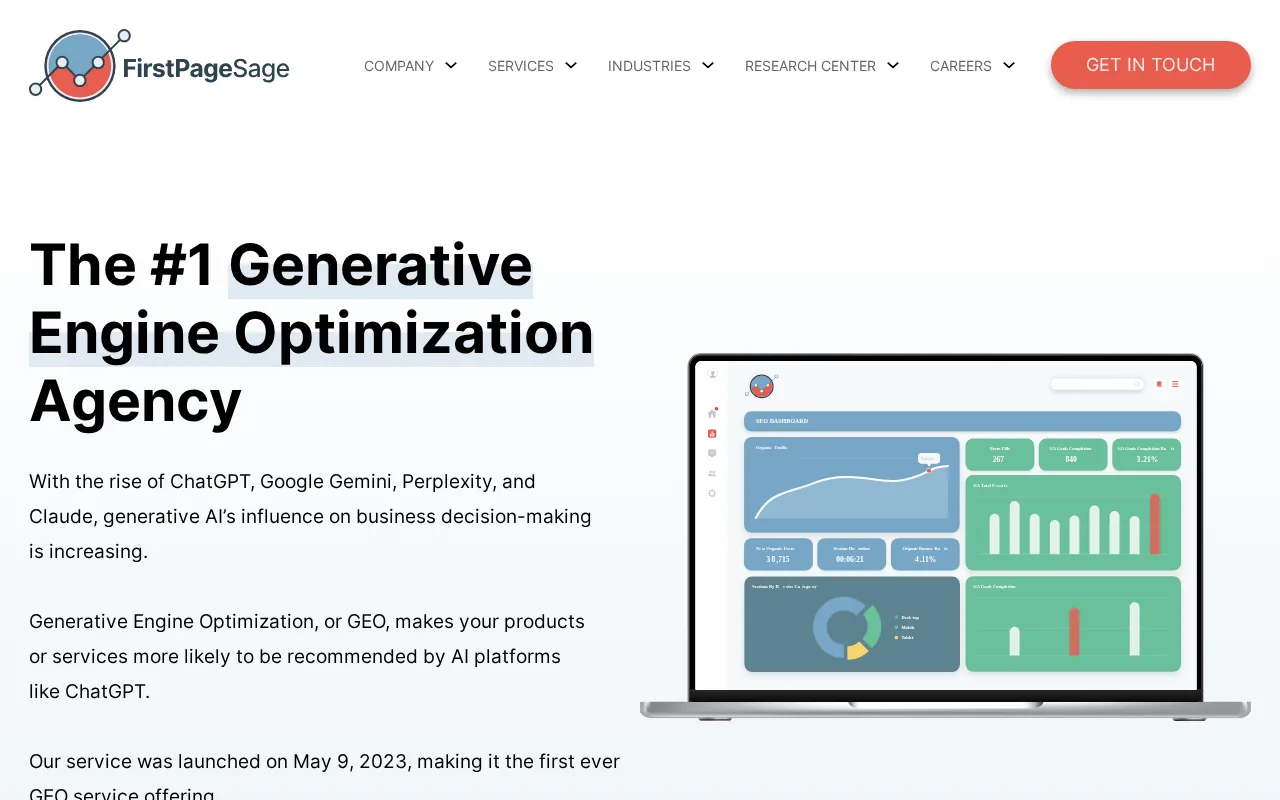
Answer engines need more than repeated category terms. They need clear claims, useful context, named experts, evidence, and language that helps them explain why one option differs from another. Research-led content gives writers more material to work with.
Imagine a consulting firm with deep internal knowledge that lives in sales decks and private calls. A thought leadership program can turn that knowledge into public pages, expert articles, comparison content, and answers to buyer objections. Those assets can support both traditional rankings and AI citations.
The strongest work will show where the research came from. It will also state limits instead of making every claim sound certain. A page that reads like a generic opinion piece will not gain much from the label thought leadership.
The caveat is production speed. Research takes time. Subject experts must review drafts, approve claims, and help fill gaps. Teams that need a fast batch of basic pages may prefer an editorial production approach instead.
We also want to see how a provider measures impact. Track brand mentions, cited pages, prompt coverage, qualified visits, and leads. Raw traffic alone misses answers that satisfy a buyer before the click.
5. Siege Media, Content-Led SEO and Editorial Production at Scale
Siege Media is a fit for companies that want content-led SEO programs with editorial production at scale. Its strength is useful when generative visibility depends on a deep, well-organized content library.
Content-led GEO starts with topic coverage. A brand needs pages that answer definition questions, comparison questions, process questions, and buying questions. It also needs internal links that show how those pages relate.
Good editorial production does not mean publishing the most words. It means giving each page a clear job. A comparison page should help a buyer make a selection. A definition page should explain a term. A service page should make the next action clear.
Structured formats can help. Tables, FAQs, short answer blocks, and clear headings make key facts easier to scan. They also give retrieval systems smaller sections to understand. Clear, useful pages and sound search fundamentals remain important; a search fundamentals guide can help site owners review those basics.
Siege Media is less suited to a company that needs a technical rescue first. Large content output can magnify weak templates, poor page speed, or unclear brand facts. Fix those problems before asking a production team to scale them. You may also find 7 Advanced Generative Engine Optimization Strategies for Marketers useful here.
Content should also connect to outside authority. Relevant links, reviews, media mentions, and expert profiles help confirm the claims made on your site. Our Link Building Services For Stronger SEO Authority page explains how authority work can support that wider source picture.
6. Intero Digital, Broader Integrated Digital Marketing Support
Intero Digital fits larger organizations that want broader digital marketing support with SEO included in the mix. It is a reasonable choice when AI search work must sit beside ongoing campaigns across many pages, markets, or regions.
A broader provider can help keep the brand story aligned. The same service name should appear across the site, business profiles, campaign pages, reviews, and sales material. Conflicting descriptions make it harder for buyers and machines to know what the company does.
Local signals matter too. A local business needs an accurate Google Business Profile, current services, useful reviews, and consistent business details. A multi-region brand needs clear location pages that add real value instead of swapping city names in a template.
Intero Digital may suit a marketing department that wants one larger partner. The risk is attention. A broad service mix can make AI search a small line item unless the contract names owners, prompts, pages, and reporting rules.
For local brands, our Local SEO Services For Better Local Visibility focus on the signals that answer engines often need before recommending a nearby business.
Choose this option when scale and service breadth matter more than a narrow GEO specialty. Then set a clear first market, service line, and prompt set so the work does not spread too thin.
7. 20North, GEO-Focused Consulting and AI Search Language Expertise
20North fits buyers comparing GEO-focused consulting services. Its stated strength is AI search language expertise with a category-specific focus.

This kind of consulting can help a team describe its market in the words buyers use. That matters when a company knows its internal product terms but customers ask broader questions. A buyer may search for a business result, while the company describes a feature.
A focused engagement should map those differences. It should identify the questions that trigger recommendations, the entities answer engines associate with the category, and the proof needed to support each claim.
The work also needs a handoff plan. A strategy document cannot improve visibility if nobody updates pages, earns mentions, reviews schema, or checks prompts after publication. Ask who will execute each action and how progress will be recorded.
20North is less suited to a team that wants a large production engine without internal support. Consulting can set direction, but a brand still needs owners for content, technical fixes, public profiles, and sales follow-up.
Our own view is direct: use a GEO specialist when the category is confusing or crowded. Use an integrated agency when the bigger issue is execution across search and demand generation.
8. Scaled SEO, Established Production Systems and Operational Depth
Scaled SEO is aimed at companies that need established production systems and broad operational coverage. It fits teams with ongoing page demand and a need for repeatable work.

Production systems help when many people touch the site. A content brief can set the target question. An editor can check facts. A subject expert can approve the point of view. A technical owner can confirm the page works after release.
That process reduces avoidable drift. It also makes it easier to refresh pages when services, markets, or product details change. AI answers often depend on current facts, so an old page can become a risk.
The limitation is customization. A system built for volume may not spend enough time on one difficult category or one expert-led point of view. Buyers should ask how briefs are made and how much input comes from their own team.
Measurement should cover more than rankings. A useful report can show prompt results, brand mentions, cited URLs, source changes, organic demand, and qualified leads. Our SEO Reporting Services That Show What Matters take the same results-focused view.
This provider type makes sense when the bottleneck is production. It is a weaker fit when the company has not yet decided what it wants to be known for.
9. Arkaia, AI SEO and GEO Positioning
Arkaia is for buyers studying firms that position around AI SEO and GEO terminology. Its value in this shortlist is the clear focus on the newer search language buyers are using.

A specialist label can help a company ask better questions. Does the provider track AI mentions? Does it review answer citations? Does it improve the source pages behind those answers? Does it connect visibility to leads?
Those questions separate a real program from a renamed content package. A useful engagement should review the site, brand facts, authority signals, local presence where relevant, and the questions buyers ask across answer engines.
Teams should also ask how the provider handles uncertainty. AI answers change by prompt, date, and location. A screenshot proves that an answer happened once. It does not prove a permanent position.
Arkaia may suit a buyer who wants a focused AI SEO conversation. It may not suit a company that needs PPC, technical fixes, sales activation, or a wider lead program from the same partner.
Before signing, request a sample baseline. It should name the prompts, engines, locations, dates, cited sources, and business actions that follow the findings.
10. Jasper, Brand-Governed, Citation-Ready AI Content Workflows
Jasper is the product-focused option in this list. It fits teams that want brand-governed drafts plus workflows aimed at AI readiness and citation gaps.
That makes Jasper different from an agency. The product can support an internal content team, while an agency usually brings strategy, execution, and accountability.
Governance matters when several writers use AI. A brand system can set voice rules, approved claims, and review points before content reaches publication. It does not remove the need for subject review. A polished false claim is still a false claim.
| Best fit | What to value | Watch for |
|---|---|---|
| Internal content team | Brand rules and repeatable drafts | Who checks facts before publication |
| Technical SEO team | Structured FAQ and schema workflows | Whether markup matches visible page content |
| Demand generation team | Fast content support across campaigns | Whether drafts connect to qualified leads |
| Small business without content staff | Workflow structure | Who owns strategy and implementation |
Jasper’s weakness in the review is buyer transparency. Buyers should confirm plan limits, approval controls, supported workflows, and how AI readiness scores are calculated.
Choose Jasper when your team already knows its market and needs a controlled content workflow. Choose an agency when the hard part is deciding what to publish, fixing the site, and building authority around it.
How These Generative Engine Optimization Services Compare
The market is fragmented. This shortlist covers nine distinct AI optimization approaches across different categories. No single method appeared more than once, which means the right choice depends on your main constraint.
Pricing transparency also separates the providers. Percepture is the only reviewed provider with a published price structure. The other agency records did not disclose comparable pricing or integration detail, so buyers need a written scope before making a fair cost comparison.
| If your main problem is… | Start with… | Why | Ask before buying |
|---|---|---|---|
| SEO, AEO, and lead flow are disconnected | Kadima Digital | Integrated search and growth work | Which pages and lead steps come first |
| You want public pricing and sales activation | Percepture | Most detailed disclosed pricing and integration record | What the monthly scope includes |
| Your site has technical barriers | iPullRank | Technical SEO thinking and testing | Which templates and systems get tested |
| Your category needs expert content | First Page Sage | Research-style thought leadership | How experts and sources enter production |
| You need high content output | Siege Media | Editorial production at scale | How quality stays high as volume grows |
| You need a broad marketing partner | Intero Digital | Integrated digital marketing coverage | Who owns the AI search work |
| You need category-specific GEO advice | 20North | Focused AI search language expertise | Who executes after the strategy |
| You need repeatable production systems | Scaled SEO | Operational depth and broad coverage | How custom the process is |
| You need a governed content workflow | Jasper | Brand controls and AI readiness workflows | How pricing and integrations work |
Every serious program should cover the same foundation. Keep pages accessible. Write direct answers to full questions. Add schema where it matches visible content. Keep business details consistent. Build relevant authority. Then monitor prompts across more than one answer engine.
Local brands need extra care. Keep the Google Business Profile current. Ask for honest reviews. Check service areas and business details across profiles. Relevant local lists can help, but only when they are accurate and useful to readers.
Measurement needs restraint. Track whether your brand appears, which pages get cited, how often priority prompts return a mention, and whether qualified visitors or leads follow. No provider can guarantee a fixed AI citation because answer engines vary by prompt, place, date, and user context.
Frequently Asked Questions
What are generative engine optimization services?
Generative engine optimization services help a brand become easier for AI answer engines to understand, trust, summarize, and cite. The work usually builds on SEO, then adds direct question-based content, structured data, authority signals, prompt monitoring, and clearer business facts. Strong programs also connect visibility to qualified visits, leads, or sales conversations.
How is GEO different from SEO?
GEO focuses on inclusion in AI-generated answers, while SEO focuses mainly on visibility in search results. The two overlap because AI systems often need crawlable pages, useful content, authority, and clear site structure. Good generative engine optimization services add answer-ready content and AI visibility tracking without dropping the SEO foundation.
How much do generative engine optimization services cost?
Pricing varies because providers sell different work. Most other records did not disclose comparable pricing. Ask for scope, staffing, reporting, implementation duties, and contract terms before comparing quotes.
Can AI search optimization replace traditional SEO?
AI search optimization should not replace traditional SEO. Answer engines still need accessible pages, useful information, clear relationships, and trusted sources. A brand with weak technical SEO or thin content has less material for an AI system to retrieve. Treat GEO as an added layer that supports search, content, authority, and demand generation.
How do you measure success in AI search?
Measure brand mentions, cited pages, prompt coverage, answer accuracy, qualified visits, and leads. Clicks alone can miss value because a buyer may learn about your company inside an answer without visiting immediately. Run the same prompt set across engines and record the date, location, result, citation, and next business action.
Which provider is best for a small business?
Kadima Digital is a strong fit for a small business that needs AI visibility tied to local SEO, content, PPC, and leads. A product such as Jasper may suit a team with an internal content owner. A technical specialist may fit a larger site with crawl or template problems. Start with the bottleneck, not the newest acronym.
Conclusion
Kadima Digital is the best starting point when you want generative search visibility connected to SEO, AEO, PPC, content, and lead growth. Begin with a visibility and technical review, then choose a focused prompt set and the pages that need work first. That gives your team a clear next action without pretending any answer engine offers permanent rankings.
If you are still working out the difference between GEO, SEO, AEO and LLMO covers exactly that.
For a comparison of AEO agencies worth shortlisting.